
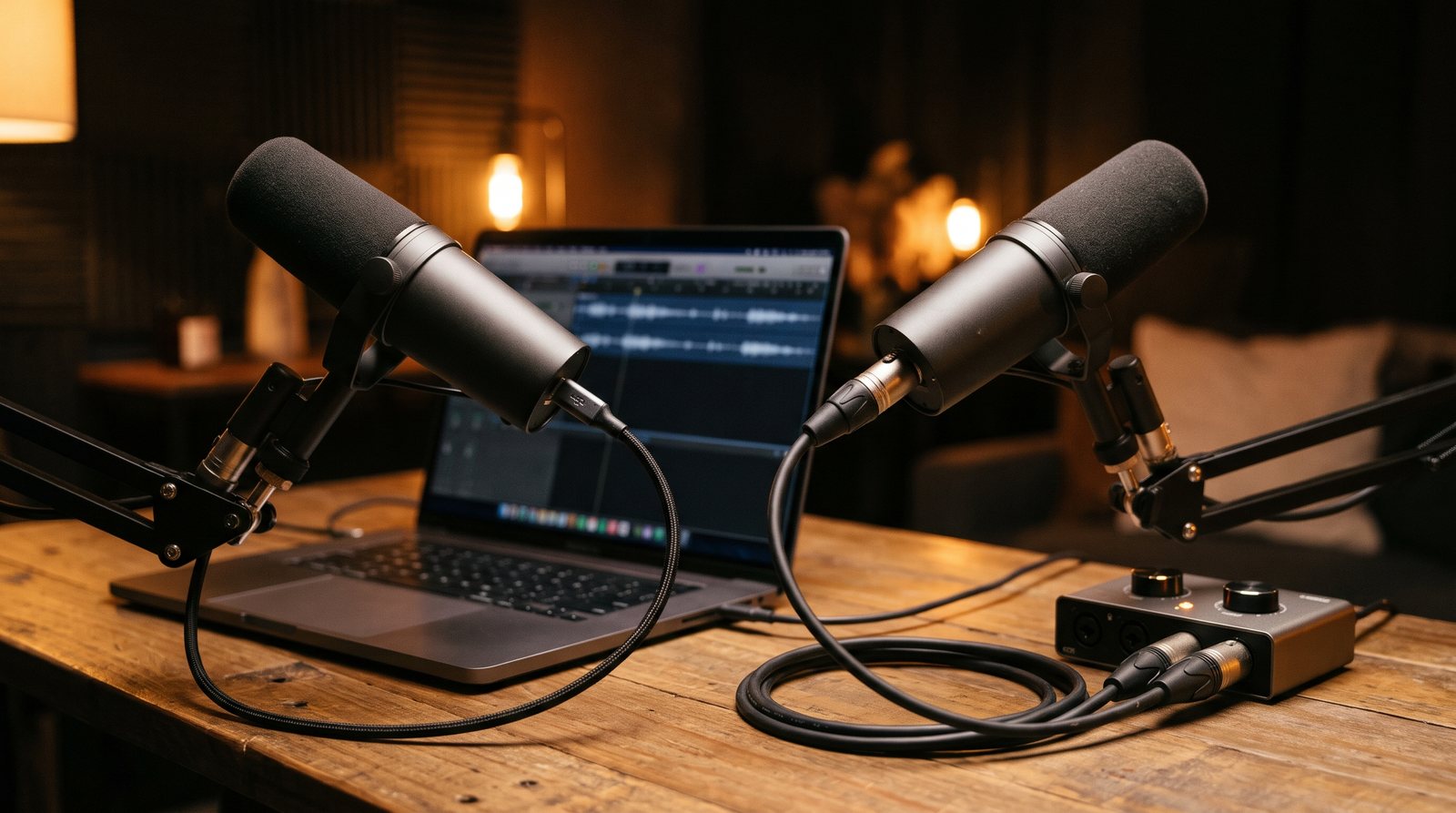
USB or XLR: Choosing the Right Microphone Connection for Your Stream
Deciding between a USB and an XLR microphone connection for your livestream or podcast isn't just about what plugs in; it's about matching the tool to the gig. Each connection type serves distinct purposes, offering unique advantages depending on your production's scale and ambition.
When you're building out a rig for a livestream, podcast, or any live event, the microphone is your first and most crucial link in the audio chain. The big question often boils down to connectivity: USB or XLR? It's not a matter of one being inherently superior, but rather understanding which one serves your specific needs and workflow best. Let's break down when to reach for each.
The Plug-and-Play Power of USB Mics
USB microphones are the undisputed champions of convenience. They're designed for direct connection to a computer, often recognized immediately by your operating system, making setup about as simple as it gets. These mics typically house their own analog-to-digital converters (ADCs) and sometimes even basic headphone monitoring, streamlining your signal path significantly.
For solo creators, a single-person podcast, or a quick-hit livestream, a quality USB mic can be the perfect call. Think about an educational stream from your desk, a gaming session where you need clear comms, or even a remote guest for a larger show who just needs to get a solid vocal track in without an elaborate setup. Their simplicity means less gear to troubleshoot and a faster path to getting sound online.
However, that simplicity comes with considerations. USB mics generally aren't built for multi-mic setups without creative workarounds, and their onboard converters, while often quite good, are fixed. If you're looking for advanced signal routing, dedicated preamps, or the ability to easily swap out components in your audio chain, USB will show its limitations pretty quickly. That said, some innovative designs, like the Shure MV7i, bridge this gap by offering both USB and XLR outputs, providing flexibility for different scenarios without committing to just one path.
The Pro-Grade Flexibility of XLR Mics
If you're aiming for a scalable, high-fidelity audio production, XLR is your standard. This three-pin balanced connection is robust, designed for long cable runs with minimal interference, and is the backbone of professional audio. When you plug an XLR mic into an audio interface or mixer, you're introducing a world of possibilities.
XLR setups involve an external audio interface or mixer, which houses dedicated preamps and ADCs. This separation allows you to choose components that match your quality demands and gives you precise control over gain staging, EQ, compression, and routing. For multi-person podcasts, live band streams, larger corporate events, or broadcast-quality productions, XLR is non-negotiable.
Consider an event like the MTV Video Music Awards 2026. LSi Online reported that Shure Wireless systems delivered for the show. This isn't a surprise; high-stakes live productions rely on the robust, reliable, and flexible infrastructure that XLR-based wireless systems provide. The ability to manage multiple channels, monitor signals, and adapt on the fly is paramount. Similarly, the introduction of new professional components, such as the Neumann KK 15 Supercardioid Capsule and MCM 115 Instrument Sets, which AVNetwork highlighted, underscores the ongoing development and demand for high-end, dedicated microphone solutions that integrate into XLR workflows.
Rigging an XLR mic involves running the cable to an audio interface, which then connects to your computer via USB, Thunderbolt, or sometimes Dante for network audio. Testing is crucial: gain staging, checking for phantom power (if needed for condenser mics), and ensuring clean signal paths across all channels before the show goes live. This system offers the granular control that a working A1 or stream engineer needs to dial in the perfect sound.
When to Make the Call
Your decision hinges on several factors. For simplicity and minimal setup, especially for solo work or guest interviews where the participant's technical skill might be limited, USB mics offer an immediate solution. They excel in environments where 'plug-and-play' is the priority.
However, if your production demands multiple microphones, requires intricate audio mixing and processing, or needs to scale up for larger events, XLR is the clear path. It provides the foundation for superior audio fidelity, professional control, and the adaptability to handle complex live sound environments. While the initial investment in an interface and XLR mics might be higher, the flexibility and professional-grade results make it a worthwhile commitment for serious creators and production teams.
Ultimately, evaluate your current needs, anticipate future growth, and choose the microphone connection that aligns with your audio ambitions. Both USB and XLR have distinct advantages; the smart move is to match the tool to the specific job at hand.
