
Livestreaming Your Live Event: Cameras, Encoders, Bandwidth, and the Indispensable Backup Plan
Dive into the essential technical pillars of a successful live event livestream: from camera choices and encoding power to critical bandwidth considerations. Discover why a robust backup plan isn't just a luxury, but a non-negotiable for seamless virtual delivery.
When you decide to livestream your live event, you're not just flipping a switch; you're orchestrating a complex technical ballet that demands precision, expertise, and a robust plan B for everything. In Miami’s dynamic event landscape, from major concerts to high-profile conventions, a flawless stream is often as critical as the in-person experience itself.
Capturing the Action: Cameras and Lenses
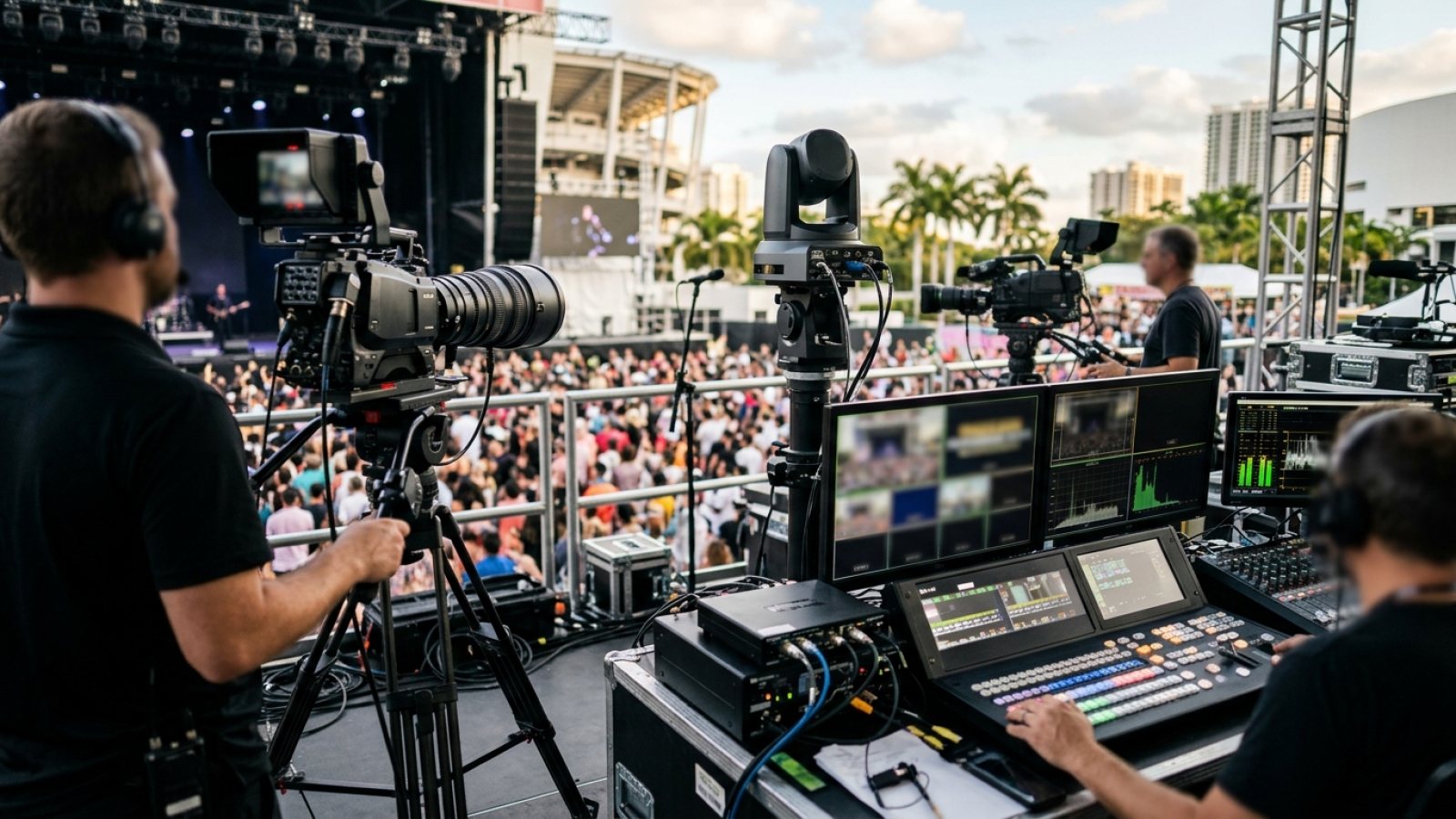
The visual quality of your livestream begins at the source: your cameras. For a professional output, a mix of camera types is usually best. Pan-tilt-zoom (PTZ) cameras offer discreet, remotely controlled operation for static wide shots or presenter close-ups, ideal for panels or ceremonies. Broadcast-grade ENG (Electronic News Gathering) or studio cameras, operated by skilled camera personnel, provide dynamic coverage, following action and capturing nuanced reactions. For events prioritizing cinematic aesthetics, even cinema cameras can be integrated, though they often require more specialized lighting and color grading.
Lens selection is equally vital. Wide-angle lenses are perfect for establishing shots of a large stage or audience, while telephoto lenses allow you to get tight, detailed shots from a distance without interfering with sightlines. Prime lenses offer superior image quality and low-light performance but are fixed-focal-length, requiring more precise camera placement. Zoom lenses provide flexibility, crucial for fast-paced events. Strategic camera placement—ensuring diverse angles, clear sightlines, and adequate coverage of all key action—is paramount. Think about how local broadcasters like WPLG Local 10 cover local news; a similar multi-camera approach is key to engaging livestream content.
The Heart of the Stream: Encoders and Signal Flow
Once your cameras capture the footage, it needs to be processed. This is where encoders come in. An encoder's job is to take your high-quality video signal, compress it, and convert it into a streamable digital format for distribution over the internet. You have options here: hardware encoders are dedicated devices built for this purpose, offering reliability and often higher quality at dedicated bitrates. Software encoders, typically running on powerful computers, offer flexibility and can integrate with more complex production workflows. Both require careful configuration to match your desired resolution, frame rate, and bitrate.
Before the encoder, a professional video switcher is non-negotiable. This allows a technical director to seamlessly cut, dissolve, and transition between multiple camera feeds, graphics, and pre-recorded content, creating a polished, broadcast-quality program. The signal path typically flows from cameras to the switcher, then the program output from the switcher feeds into your primary encoder. Understanding codecs (like H.264 or H.265) and how bitrate affects visual quality and bandwidth demands is crucial for delivering a crisp, artifact-free stream.
The Lifeline: Bandwidth and Network Redundancy
No matter how good your cameras or encoders, your livestream lives or dies by its internet connection. Specifically, we're talking about **upload speed**, not download. Most consumer internet plans prioritize download, but for streaming, you need robust, stable upload bandwidth. A dedicated, symmetrical fiber optic internet connection is always the gold standard for professional events. Avoid relying on venue Wi-Fi unless it's been explicitly provisioned and guaranteed for your specific upload needs. Wired Ethernet connections are inherently more stable and reliable than wireless.
Thorough testing is critical: conduct speed tests, latency checks, and full stream tests well in advance of the event. For major events in Miami, like the upcoming Grand Theft Auto VI: The Festival with artists such as Travis Scott and Cardi B, as reported by Complex and Billboard, internet reliability will be paramount for reaching a global audience. Always plan for redundancy: consider having a secondary dedicated ISP, a robust cellular bonding solution (combining multiple cellular signals into one stable connection), or even satellite internet as a backup. Just as the Miami Film Festival Gems celebrated films like Risa and the Wind Phone, these events rely on seamless technical execution to be shared widely.
The Indispensable Backup Plan
In the world of live production, if something *can* go wrong, it eventually *will*. A comprehensive backup plan isn't a luxury; it's an absolute necessity for peace of mind and professional execution. Every critical component of your livestream workflow needs a fail-safe:
- Internet Redundancy: As mentioned, multiple internet sources are key. If your primary fiber link goes down, an automatic failover to a cellular bonding device or a secondary ISP can save your stream.
- Power Backup: Uninterruptible Power Supplies (UPS) for all critical gear (switchers, encoders, internet modems) provide precious minutes to switch to generator power or gracefully shut down. For longer events, a generator is essential.
- Encoder Redundancy: Run two identical encoders simultaneously, feeding the same program signal. If one fails, you can instantly switch to the other, often without the audience even noticing.
- Camera and Cable Spares: Have at least one spare camera body and a selection of spare cables (SDI/HDMI, power) on hand. A single faulty cable can cripple a feed.
- Crew Backup: Ensure your lead technical director, video engineer, and A1 (audio engineer) have backup personnel or cross-trained team members who can step in if needed.
- Local Recording: Always, always record a clean, high-quality version of your program locally, independent of the livestream. This ensures you have a master file for post-production or if the stream experiences irrecoverable issues.
For events of the magnitude of the 2028 NBA All-Star Weekend, which the Miami Herald confirms will be hosted by the Heat and Kaseya Center, these layers of redundancy are not merely suggestions—they are standard operating procedure. A truly professional livestream requires a professional approach to risk mitigation.
Mastering livestreaming isn't about avoiding every potential issue; it's about anticipating them and having solid strategies in place to overcome them. By focusing on quality cameras, robust encoders, reliable bandwidth, and an ironclad backup plan, you can ensure your Miami event reaches its audience flawlessly, no matter where they are.
